Email copiado — support@tuurt.com
Cargando experiencia
Tuurt / Labs / Cerberus
Tuurt Labs · Our own product

Cerberus

An algorithmic trading system for MetaTrader 4 where account protection does not depend on the strategy. Two heads on a single chart: an always-on guardian that polices every position in the terminal, and a strategy that trades. When the strategy is wrong, the guardian still does its job.

In production High-risk instrument MetaTrader 4 XAUUSDm · BTCUSDm
Architecture
Two headsGuardian independent of the strategy
Safety net
TripleDaily loss · basket · broker-side stop
Instruments
Gold and BTCXAUUSDm · BTCUSDm, hedging account
Licence
Per accountOnline check · 72 h offline grace

Read this before you scroll any further

Cerberus trades leveraged CFDs on gold and crypto. It can cost you your entire capital. It is not financial advice, not a promise of returns, and no past result guarantees a future one.

On this page we publish the numbers we measured and also the ones that came out badly. If you are looking for a page that only shows you the pretty curve, this is not it. We would rather you decide with the full picture than decide quickly.

How it works

Two heads, one chart.

Most robots mix entry logic with protection logic. When the strategy fails, the protection fails with it. Cerberus separates them: the guardian has no idea what the strategy thinks, and that is exactly why it can cut it.

01 — ALWAYS ON

The guardian

It polices every position in the terminal, including those of other robots and the ones you open by hand. It holds no opinion about the market: it only measures how much you are losing and acts.

  • Daily-loss cutout. If the account drops by the amount you set from the day's baseline, it closes everything and stays paused until you re-arm it by hand.
  • Per-basket stop. If a group of positions accumulates a floating loss beyond the limit, it cuts that basket and waits out a cooldown before re-arming.
  • That same stop, mirrored at the broker. The part that matters most: it rests as an SL order on the server. If your terminal goes down or the broker rejects our close orders, the broker-side stop still exists.
  • News filter. On a high-impact event it stops opening new positions (±30/45 min). It does not close open ones: closing into a news spike realises the loss that the normal basket exit usually recovers.
02 — THE ONE THAT TRADES

The strategy

It enters against the move and averages down with a constant-lot grid. This is the part that carries the real risk, and we describe it exactly as it is so you know what you are running.

  • Direction: it fades. A Gann HiLo indicator marks the trend side and the entry is the opposite one: it buys the fall and sells the rise.
  • Additive grid, not martingale. Each adverse level adds a position of the same lot. Size is never multiplied. Depth is bounded by a capital-proportional cap.
  • Hybrid exit. Each order carries its own target on the server, and the whole basket also closes once its floating equals one target shared across the open positions. A deep grid clears on a small bounce.
  • Trailing target on the server. Once a lone position moves into profit, the exit becomes an order that rests at the broker and rides up with price. A code-side close leaked on us once during a tick jump; a resting order did not.
See it move

What happens when the market goes against it.

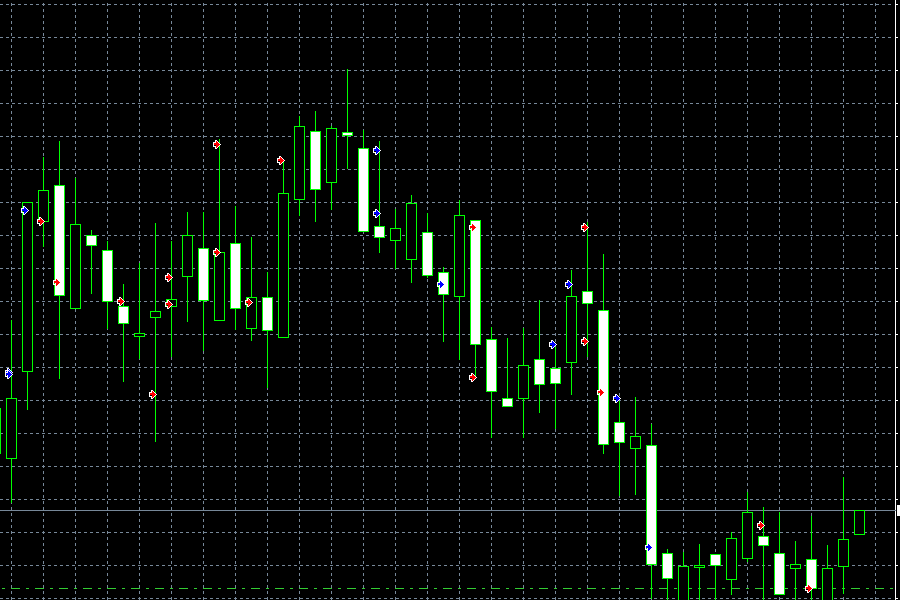
The sequence that matters most before you buy: the strategy enters, price keeps going the wrong way, the grid adds levels, and the basket stop cuts before the hole gets bigger.

Behaviour schematic — not a recording of a real account.
What we measured

The numbers, with their fine print attached.

Everything below was measured on real M1 gold (Dukascopy, 1.13 M candles) between January and July 2026, at 0.01 lot and $0.35/oz spread. No number here comes from a funded account.

MetricMeasured result
Net result+$32,272.92
Profit factor1.49
Equity drawdown$230.03
Worst basket−$65.11 (stop at $60)
Orders · winners99,368 · 96.6 %
Expectancy per order$0.3248
Positive months6 of 6 (worst: +$2,467.70)

Why that table is not enough to decide on

That same configuration loses $6,608 if you run it over 2024 (factor 0.85, drawdown $6,801). The result above describes one particular gold regime, not a law.

The sign depends on the simulator. The same configuration, the same data and the same window give +34,496 under the open-prices fill model and −93,797 under every-tick. When the sign changes with the simulator, the backtest cannot support a deployment decision — and we do not pretend it does.

A 65-configuration sweep plus out-of-sample validation produced none meeting factor > 1.2 with drawdown < 3 %. And a faithful replica of the reference bot that inspired the strategy lost −99.99 % over 2.4 years despite closing 97 % of its cycles in profit.

A high win rate is not an edge: it is a knob. The measured configuration books 96.6 % of its orders green at an average win of $1.03 against an average loss of $12.90. A system that never closes losers can show 98 % winners while carrying the open hole. Measure net dollars, not the percentage.

What we removed

Three features we deleted because we measured that they cost money.

Earlier versions carried an adaptive layer: a volatility brake, a flip-close and a switch that moved from fading the market to following it. All three sounded good. We measured them one at a time over the same window and all three came out worse than — or equal to — not having them.

Removed featureWith itWithout it
Trend brake
Reduced activity in strong moves
23,941 · f 1.38 · dd 354 36,552 · f 1.50 · dd 224
Flip-close
Closed the basket when bias inverted
36,552 · f 1.50 · dd 224 40,675 · f 1.48 · dd 294
Fade/follow switch
Changed regime based on volatility
43,898 · f 1.49 · dd 300 40,675 · f 1.48 · dd 294

And what stayed, because it survived every test

The basket stop is the one change that held across every regime and both simulators. It cut the drawdown by 63 % (606 → 224) at no cost in net result. But it has a threshold: set too close, inside the market's normal noise, it does the opposite — at $20 the drawdown quadruples to $2,331. The usable range is $60–100.

The trailing target carries most of the modelled result — without it, net falls from 40,675 to 9,389. It is also the piece that does not survive the every-tick model, so that is where the model risk is concentrated. We say so because it is the most exciting part and the least confirmed one.

First live session, 62 gold fills: average slippage of +$0.0274 per order, leaving 92 % of the modelled expectancy. It is the number no backtest can give you, and the first real measurement did not show the cost that would erase the edge. It is one session, on a demo account, where fills are more optimistic than on a real one.

Getting started

From zero to running, in an afternoon.

We hand you the package, the measured configuration for your account size, and the guide with screenshots. You need a MetaTrader 4 account with hedging enabled and, if you plan to leave it unattended, a VPS.

Write to us and we set you up

An email to cerberus@tuurt.com with your account number and broker. We issue the licence, which binds to that account.

AutoTrading button enabled on the MetaTrader 4 toolbar

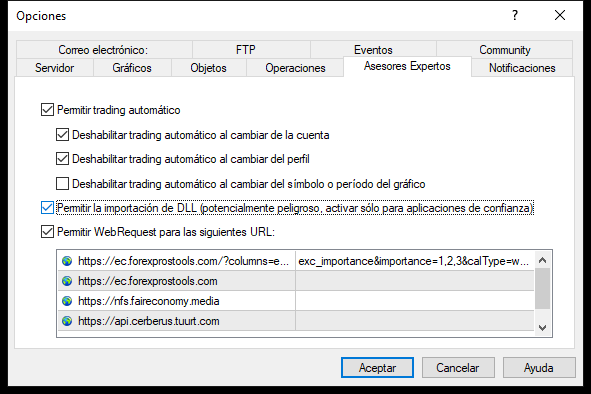
You authorise the licence URL in the terminal

Tools → Options → Expert Advisors, and paste the address that validates the licence. It is the only manual setting.

MetaTrader 4 Options window on the Expert Advisors tab with the authorised URL

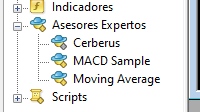
You drag the robot onto the chart

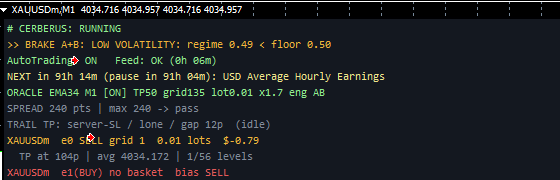
Onto the XAUUSDm chart on M1. The panel appears top-left and tells you if anything is missing.

Cerberus in the MetaTrader 4 expert advisors navigator

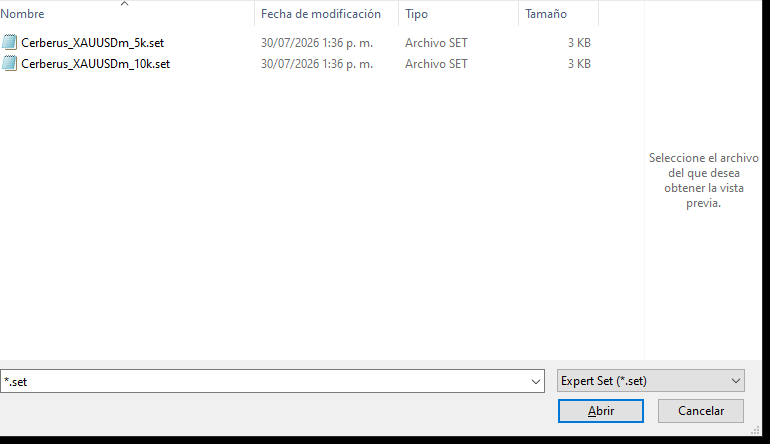
You load the preset for your account size

One .set file per tier. It fixes the number of levels, the daily cutout and the basket stop against the capital you are risking.

MetaTrader 4 properties dialog loading a Cerberus .set configuration file

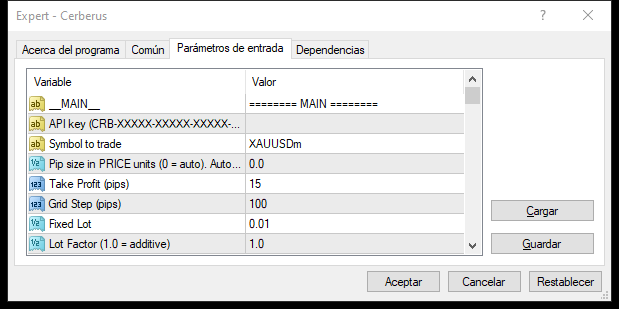
You review the parameters and start

The settings that get tuned sit right at the top, in plain language. The rest stays in advanced sections you do not need to open.

Cerberus input parameters tab in MetaTrader 4
The hard questions

The ones you would ask with ten minutes of the engineer's time.

Is this a martingale?

Not in the strict sense: lot size is not multiplied level by level. Each adverse level adds a position the same size as the previous one — it is an additive grid.

That said, let us be clear: it is still averaging down. Every new level increases exposure while price keeps going against you. Profit per cycle is capped and the potential loss is not. Not multiplying the lot slows the hole down; it does not remove it.

What happens if my computer or VPS goes down?

The robot only defends while it runs. It happened to us: a terminal sat off for 13 hours with a live basket and nothing was watching it; the cutout rule only fired on restart, with the damage already done.

That is why the basket stop is mirrored as an order on the broker's server. That order exists even when your machine does not. It is the only real cover for that scenario, which is why we recommend leaving it always on and using a VPS if you trade unattended.

And if the broker rejects the close orders?

It happens. We measured it on 22 July 2026: the broker disabled algorithmic trading during a $27/hour move in gold and every close attempt was rejected.

In that scenario the only thing that executes is the broker-side stop. Turn it off and you have no net in the one moment you actually need one.

Does it work on a small account?

Honestly: on small accounts the losses are disproportionately heavy. The 0.01 minimum lot on gold equals one ounce and cannot go below that on a dollar account.

We measured that no combination of settings moves the 2024 drawdown at that minimum lot: 1 to 5 levels, with daily caps of 100/200/400 and stops of 20/40/80, all land between $6,539 and $8,630. If your capital cannot absorb that range, let us talk before we sign you up — that is what the email is for.

Why do you publish the bad results?

Because marketing material is the first thing anyone reviews when they lose money, and because a negative result measured properly is worth more than a positive one measured badly.

Also out of self-interest: if we sign you up on false expectations, the problem comes back to us in three months. We would rather have fewer clients who understand what they are running.

What exactly do I need?

MetaTrader 4 (not MT5 — since version 2.0 the project is MT4-exclusive), an account with hedging enabled, the XAUUSDm or BTCUSDm symbol at your broker, and a stable connection. The licence validates online and tolerates up to 72 hours offline before it locks.

Do you guarantee returns?

No. Neither do we nor does anyone being honest with you. What we do guarantee is that the protection rules do exactly what this page says, that the published numbers are the ones we measured — including the ones that came out badly — and that if anything changes, we update it here.

Full risk disclosure

Cerberus is a high-risk experimental system. It is not investment advice and not a solicitation to trade. Read this in full before you buy.

  • The payoff is asymmetric. Profit per cycle is capped; the loss is not. Every adverse level adds exposure while price keeps going the wrong way.
  • It trades against the move. Averaging down works until the move that does not revert shows up. Then the whole basket is the loss.
  • It does not protect against market volatility. The guardian reacts after the move starts. It cannot predict gaps, news spikes, or a broker halting execution. Slippage, spread widening, requotes and weekend gaps are outside its control. Measured: gold reopened $35 above Friday's close.
  • It only defends while it is running. With the terminal off, the only cover is the stop order resting on the broker's server.
  • No backtest of this system has passed validation, and one result is unstable: the same configuration changes sign depending on the simulator's fill model.
  • No funded-account result has been verified or published. Every figure on this page comes from demo accounts and simulation over historical data.
  • Trading leveraged CFDs carries a high risk of losing money rapidly, including the entire deposit. You are solely responsible for whatever you run on your account.

Shall we talk before you decide?

Write to us with your account size and broker. We will tell you whether it makes sense in your case — and if it does not, we will tell you that too.

cerberus@tuurt.com